
Pima County Criminal Court Cases
Pima County criminal court cases are divided by charge level and place. The Arizona Superior Court in Pima County hears felony cases at 110 W. Congress Street in Tucson. Its clerk is the custodian of those files. The Pima County Consolidated Justice Court handles county misdemeanors, DUI matters, and criminal traffic cases within its jurisdiction. Tucson, Marana, Oro Valley, and Sahuarita each keep a separate municipal or magistrate court docket for local misdemeanors, traffic charges, and ordinance cases.
The filing court matters more than the arresting agency. A Tucson police arrest can lead to a Pima County Superior Court felony file, while a city misdemeanor may remain in Tucson City Court. Case numbers also give clues. Justice Court accepts full numbers beginning with CR, CV, or TR, though CR is the useful criminal prefix. When the court is unknown, start with the likely charge level and then check the court tied to the city where the case was filed.
The Pima County court counters are distinct. Superior Court is at 110 W. Congress Street, and the clerk can be reached at (520) 724-3200. Consolidated Justice Court is at 240 N. Stone Avenue with customer service at (520) 724-3171. Tucson City Court uses its own defendant search and (520) 791-4216. Marana Municipal Court, Oro Valley Magistrate Court, and Sahuarita Municipal Court also keep their own local files. These contacts provide a direct fallback when a public portal does not identify the filing court.
Pima County Case Portal Choices
Superior Court offers more than one access path. The Pima County Clerk case-records page routes the public to Agave Online Public Record Search, Arizona eAccess, and Electronic Court Record services for parties or attorneys. Agave provides limited public viewing of Pima County Superior Court case information. eAccess covers certain Arizona Superior Court records and may require an account or payment for documents. Party ECR access requires party status and an Arizona driver's license.
The Clerk's own case-records screen shows where official Pima County court files begin. The source page is available here.
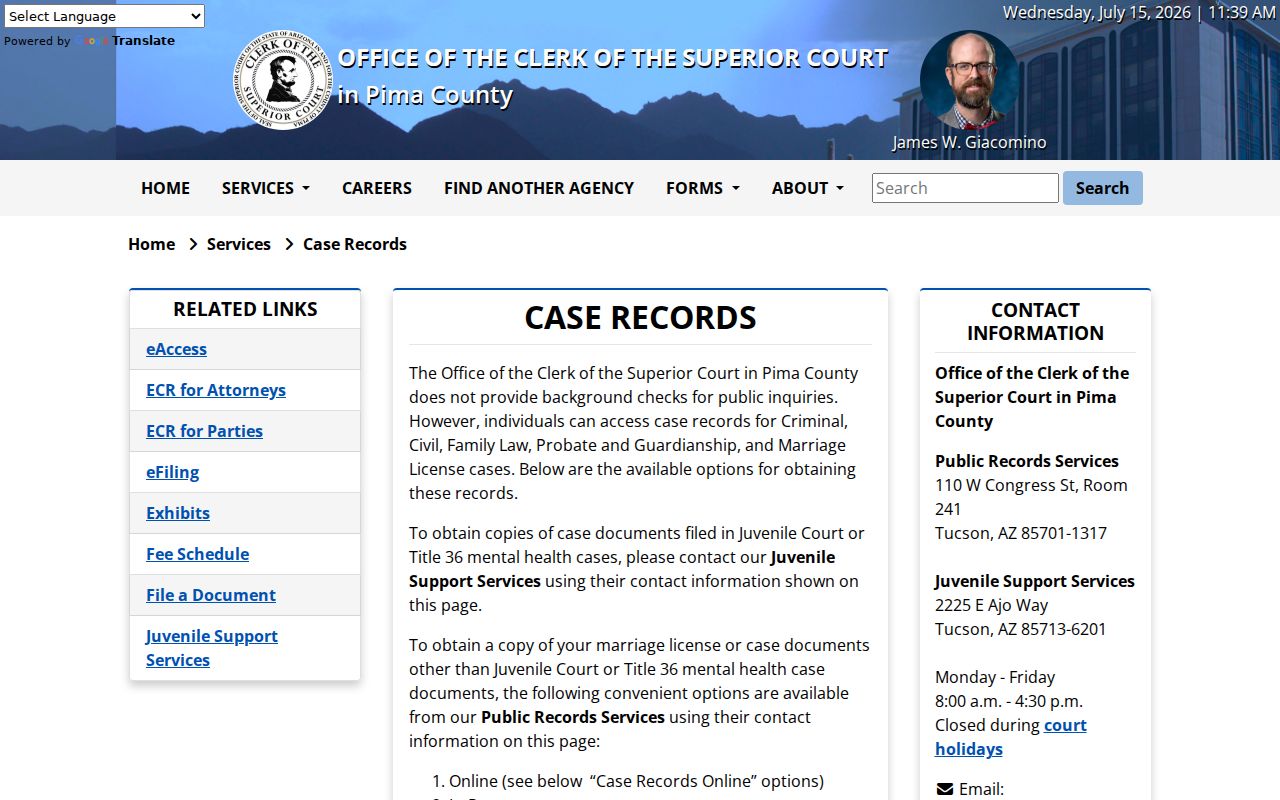
That routing page is useful when a name search finds a case but the reader still needs a filed document or a certified copy.
Searching Pima County Case Records
Search the court that has authority over the charge. A full case number is best because common names can return several Pima County criminal cases. If the portal produces no result, do not treat that as proof that no file exists. Some records are excluded online, some courts maintain their own systems, and clerk staff can search or provide copies through phone, email, mail, and counter channels.
- Identify Superior, Justice, or municipal court from the charge level and filing location.
- Use a full case number when known. Otherwise, enter the party's last and first names.
- For Justice Court, select person or business and try the complaint number if the case number is missing.
- Open the docket and read entries by date, including hearings, pleas, warrants, disposition, and sentence.
- Ask the filing court for an uncertified, certified, or complete copy when the portal shows only a summary.
The Pima County Justice Court Case Search exposes the following fields.
| Field Label | Type | Required | Notes |
|---|---|---|---|
| Last Name | Text | For name search | Person or business name |
| First Name | Text | No | Narrows a person search |
| Person / Business | Radio | Unspecified | Select the party type |
| Case Number | Text | For case search | Full number begins CR, CV, or TR |
| Complaint Number | Text | For complaint search | Separate lookup route |
The manifest capture of the Justice Court search interface shows why knowing the identifier type saves time.
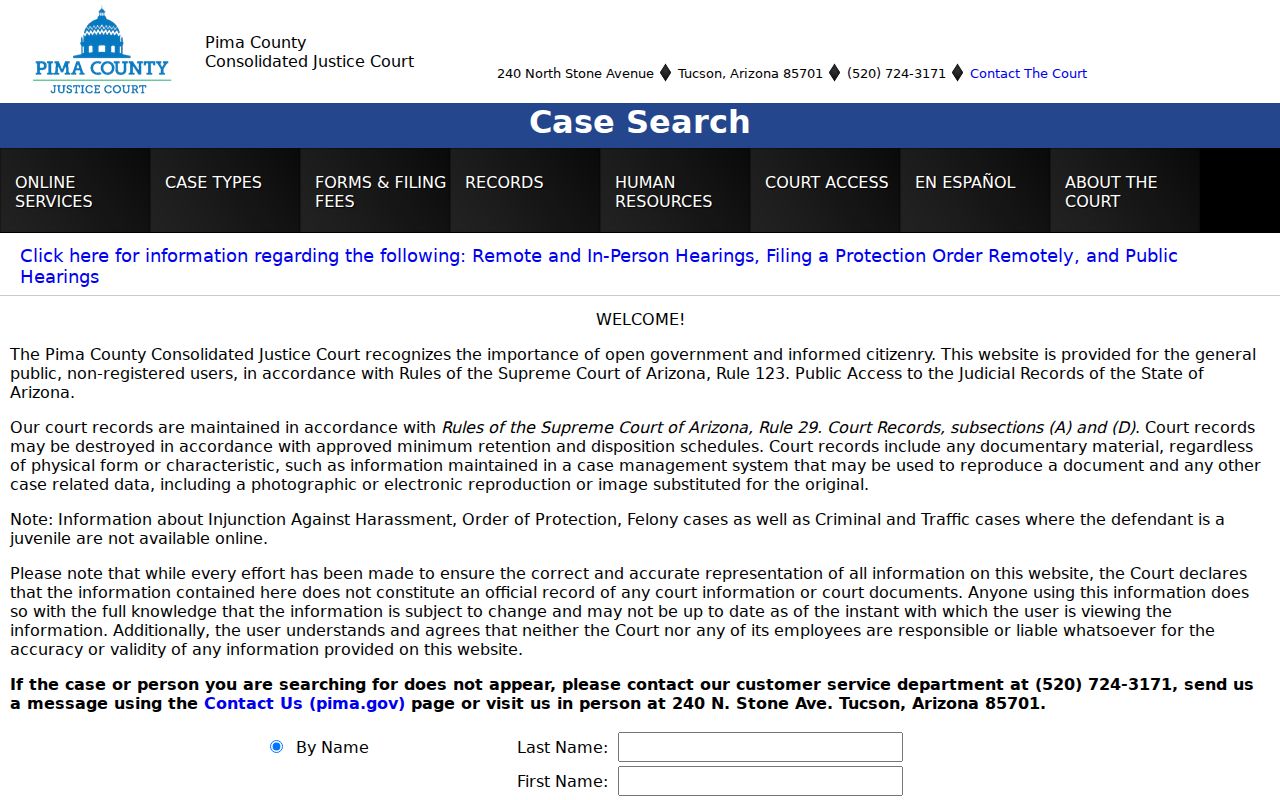
The same screen warns that its information is not the official record and can change.
Pima County Court Search Gaps
A common mistake is expecting the Justice Court search to show every Pima County criminal court case. It does not publish felony cases online, even though Justice Court handles many lower-level criminal and traffic matters. Criminal or traffic cases involving juvenile defendants are also excluded. Injunctions against harassment and orders of protection do not appear there either. Those limits come from the court's public-search notice under Arizona Supreme Court Rule 123.
The statewide Public Access to Court Case Information can help locate a reporting Arizona court, but it is also a finding aid. The official statewide lookup screen is shown in the assigned image.
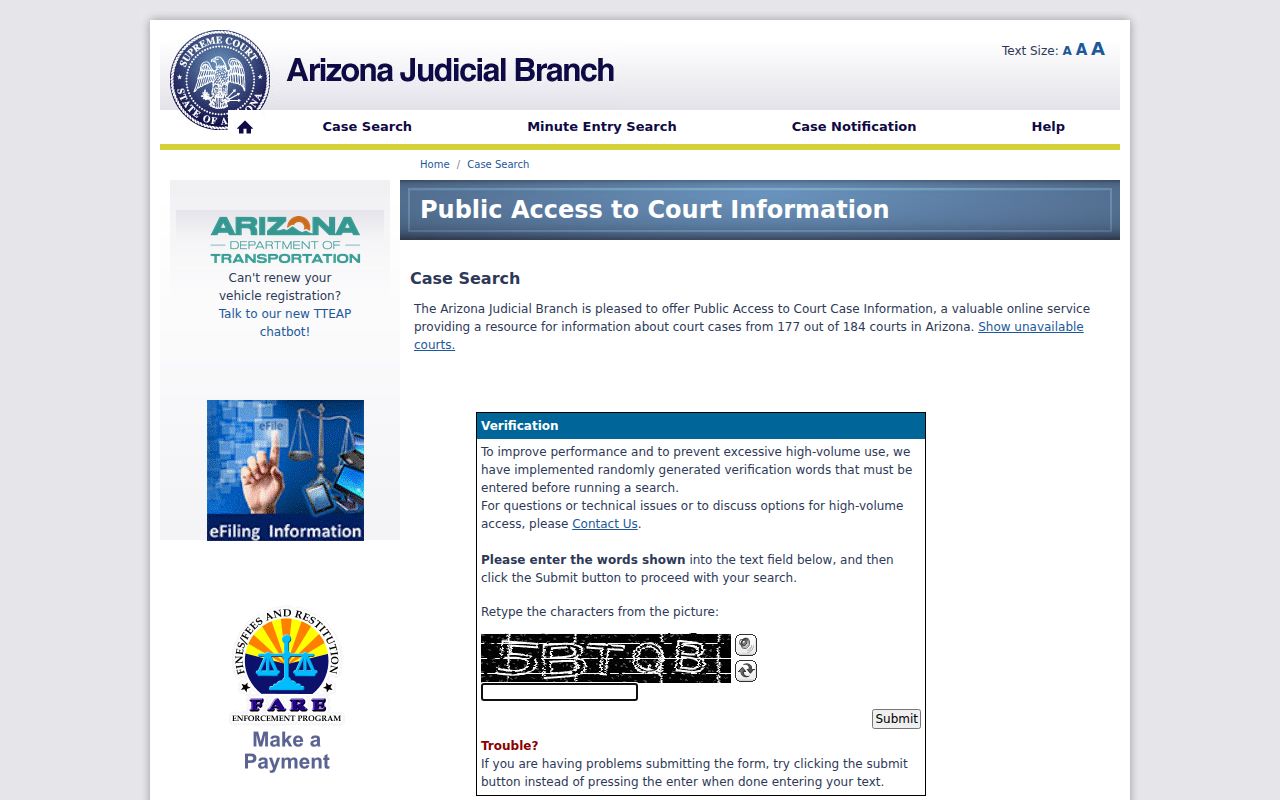
A missing statewide result should lead back to the clerk of the court that accepted the charge, not to a conclusion about the person's record.
Inside a Pima County Case File
A Pima County case file is a dated record of what happened in court. It is not the police narrative. The docket may show the complaint or indictment, arraignment, motions, hearings, plea, judgment, sentence, financial terms, warrant activity, and later appeal links. Filed charges can differ from the charge named at booking because the prosecutor decides what to bring before the court.
| Case Number & Court | The local identifier and the Superior, Justice, or municipal filing court. |
|---|---|
| Charging Document | A complaint, information, citation, or indictment stating the filed counts. |
| Docket Entries | Filings, motions, minute entries, warrants, and other events in date order. |
| Hearing Dates | Arraignment, pretrial, plea, trial, judgment, and sentencing settings. |
| Disposition & Judgment | The outcome of each charge, such as pending, dismissed, acquitted, or convicted. |
| Sentence & Conditions | Custody, probation, fines, restitution, or other terms after conviction. |
Read each charge separately. One Pima County criminal case can contain several counts with different outcomes, so the case-level word "closed" does not replace the disposition attached to each count.
Pima County Court Record Copies
When a docket summary is not enough, the Pima County clerk accepts requests in person, by email, mail, or phone. The clerk can take credit-card payment by phone for copies and postage. Closed, sealed, or confidential records may not be available for review or reproduction. Justice Court has its own records-request route, while municipal court requests go directly to the city or town court.
The assigned Agave capture comes from the Agave Online Public Record Search source.
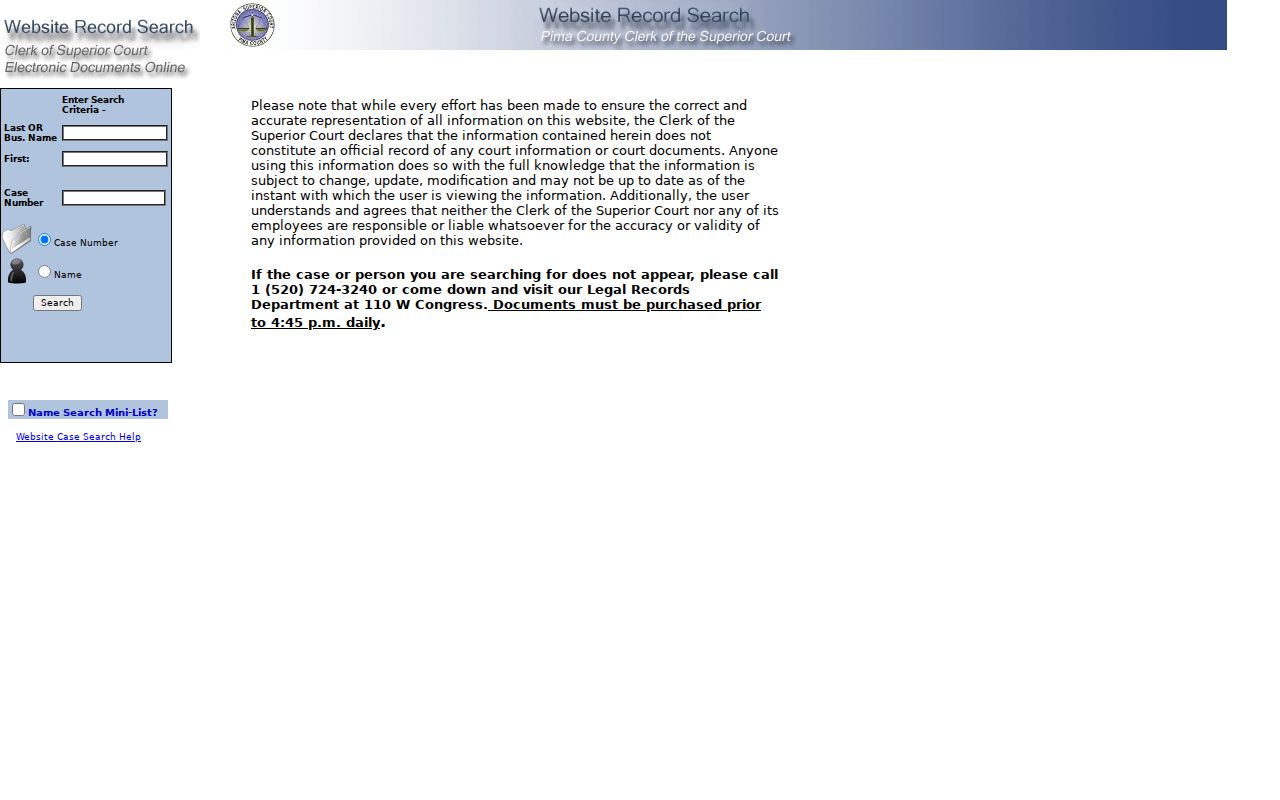
Agave is the online starting point, but clerk copy channels remain the route to documents the public screen does not supply. For Justice Court records, the official request page appears in this capture.
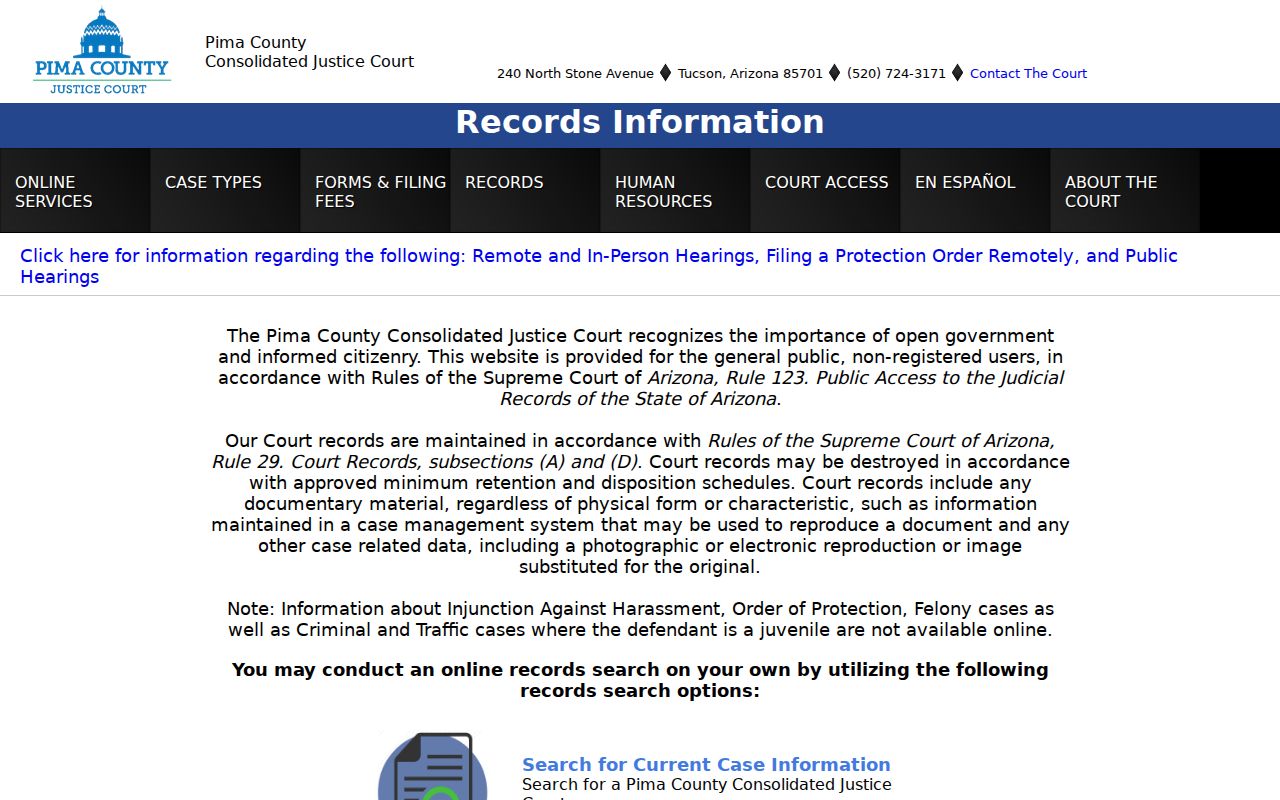
That separate page helps readers move from a changeable online summary to records released by the court itself.
How a Criminal Case Moves
A filed Pima County criminal case moves through a chain of court events. The arraignment is the first formal event where charges and a plea are addressed. Pretrial entries can include disclosure, motions, conferences, or changes to release terms. A plea agreement is a negotiated resolution. If no agreement resolves the case, the record may proceed to trial and a verdict.
Charges Filed → Arraignment → Pretrial → Plea or Trial → Disposition → Sentencing
Disposition means the outcome of a charge. It may be a dismissal, acquittal, or conviction. Sentencing follows a conviction and can add custody, probation, restitution, fines, or court costs. A bench warrant or failure-to-appear entry can interrupt the sequence. Reading the dates in order keeps an old charge from being mistaken for the current result.
Pima County Charges After Booking
The charge named at arrest is not always the charge that appears in the final Pima County court file. The Pima County Attorney's Office decides many felony charging paths after police or sheriff reports arrive. A prosecutor may file an information, seek a grand-jury indictment, change counts, dismiss a charge, or route an eligible person toward diversion. The court docket records those later choices.
This timing explains why an arrest report and a court case can tell different parts of the same event. The report records the agency's action and facts gathered at that stage. The court file records the formal charges, hearings, plea or trial, disposition, and sentence. For the initial custody trail, the separate Pima County Arrest Lookup covers the sheriff and agency channels without replacing the filed case record.
Case Record Access & Restrictions
Arizona court records are generally public, but access is governed by Arizona Supreme Court Rule 123, statutes, and court orders. A Pima County criminal case may be absent or partly redacted because it is sealed, confidential, juvenile, tied to protected victim data, or subject to another limit. A.R.S. § 13-911 permits a court to seal eligible arrest, conviction, and sentencing records from ordinary public access.
Arizona eAccess provides another state-managed document route for some Superior Court files. The official eAccess source is shown here.
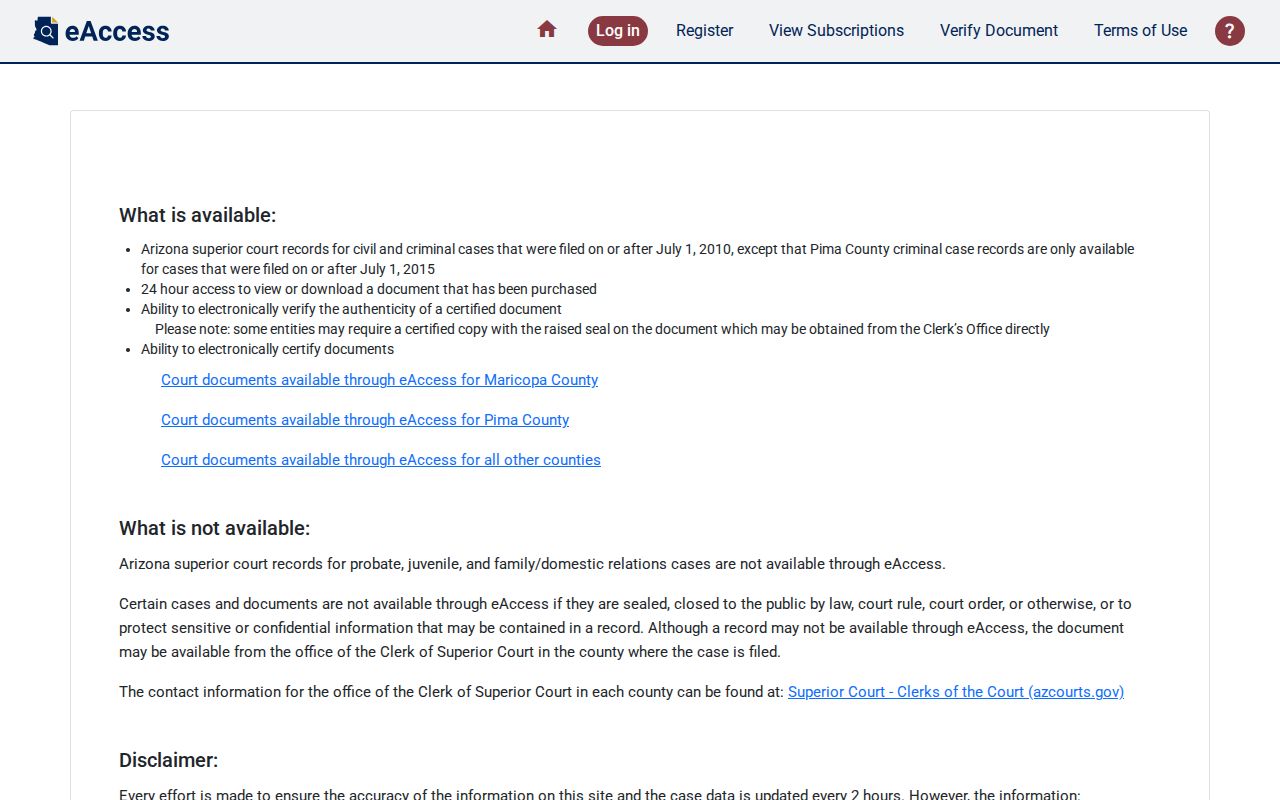
Its coverage and document access differ from a local clerk search, so the two channels should be treated as complements rather than duplicates.
Pima County Municipal Case Split
Lower-level Pima County criminal records may stop at a municipal court. Tucson City Court offers a defendant search by first and last name, docket number, or citation number. Marana Municipal Court, Oro Valley Magistrate Court, and Sahuarita Municipal Court each maintain their own town records. Their files can include local misdemeanors, civil traffic, ordinance matters, and payment or violation records.
The split is practical. A searcher who checks only Superior Court can miss a city case, while a Justice Court search does not replace the town court. If a city portal has no match, contact that municipal clerk by its form, mail, fax, phone, or counter channel. The arresting agency name and the place of the alleged offense help identify which Pima County court likely received the filing.
Tucson City Court accepts requests for uncertified copies, certified copies, case printouts, and violation letters. Sahuarita uses a Request to View Case File/Public Record form and applies its stated fees before release. Those examples show why a local docket may require a direct request even when another Pima County portal returns no result.